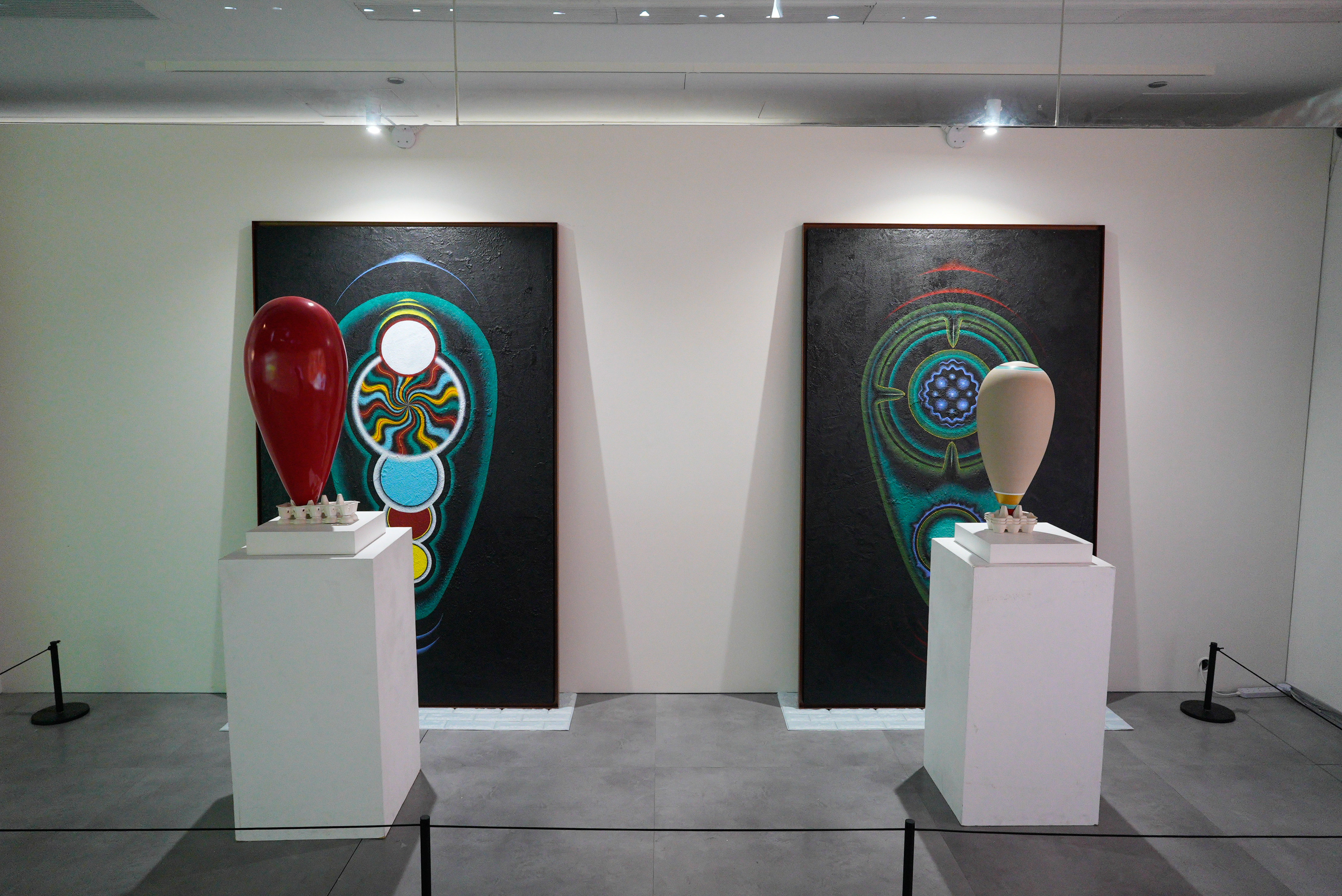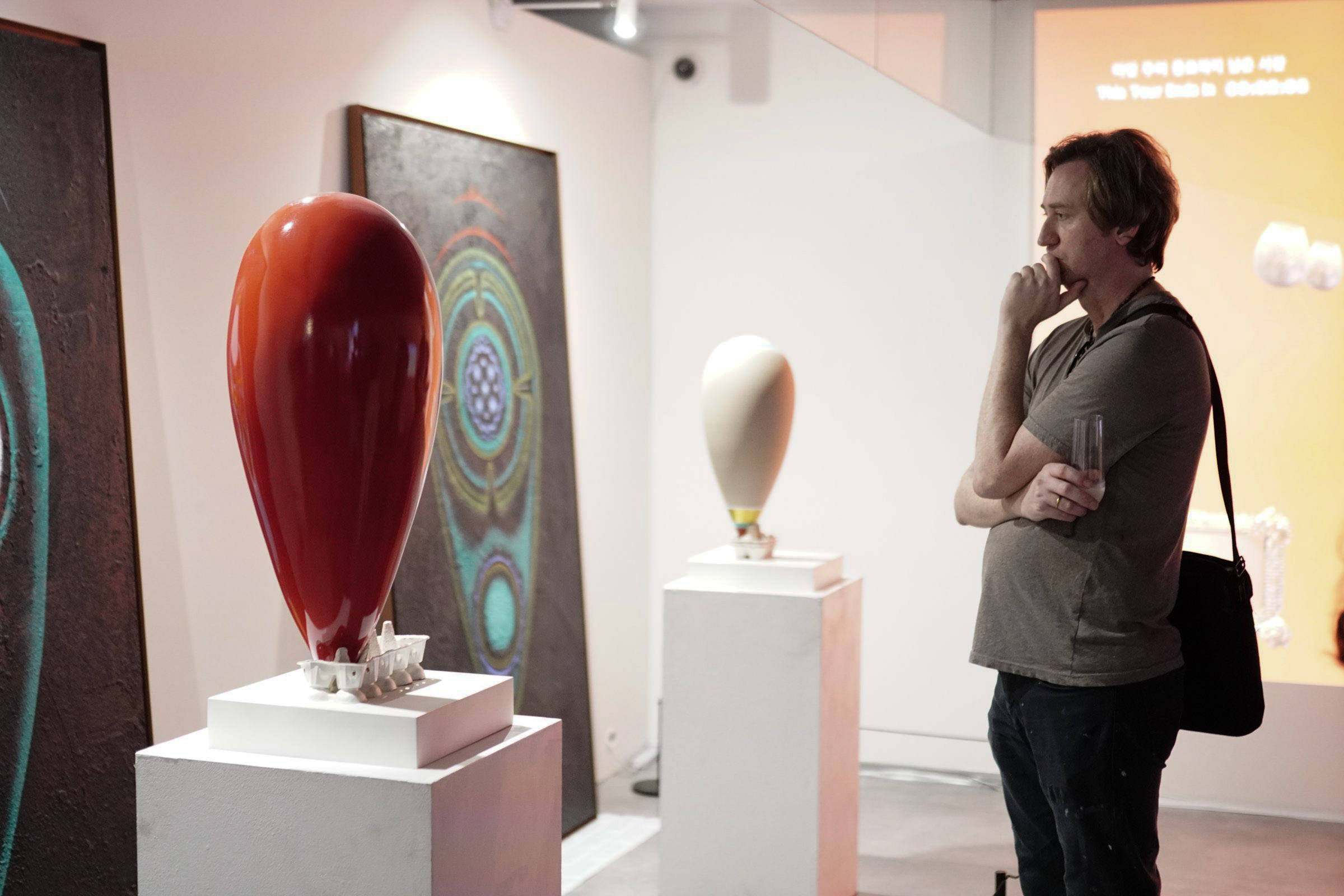
For this exhibition, selected works from Kim Sangdon's first solo exhibition in Hong Kong, The Eggs, are presented. Born to a family of shamans, Kim Sangdon is a spiritual practitioner and multidisciplinary artist whose practice investigates Korea's past, in particular the violent division of South and North Korea and the country's ruthless pursuit of modernization.
In his earlier works, Kim studied processions of people and non-human entities in traditional mourning rituals, political protest, and communal gatherings of healing. Through installations and performances, he observed a collective malaise that the novelist Choi In-hun described as "refugee mentality," referencing the rootlessness of people constantly escaping borders, whether geographical, historical, or socio-political. Yet in the ancient practice of shamanism, great emphasis is placed on boundary expansion and shape shifting. This idea, that spirituality can dissolve the violence of borders, forms the crux of Kim's practice, giving birth to new, resilient ways of being.
In The Eggs, Kim looks to the humble egg as a metaphor for spiritual growth. Small but endlessly generative, the egg appears throughout Korea's sociopolitical history, from myths of kings being hatched to present-day protests, where egging politicians has become a common ritual.
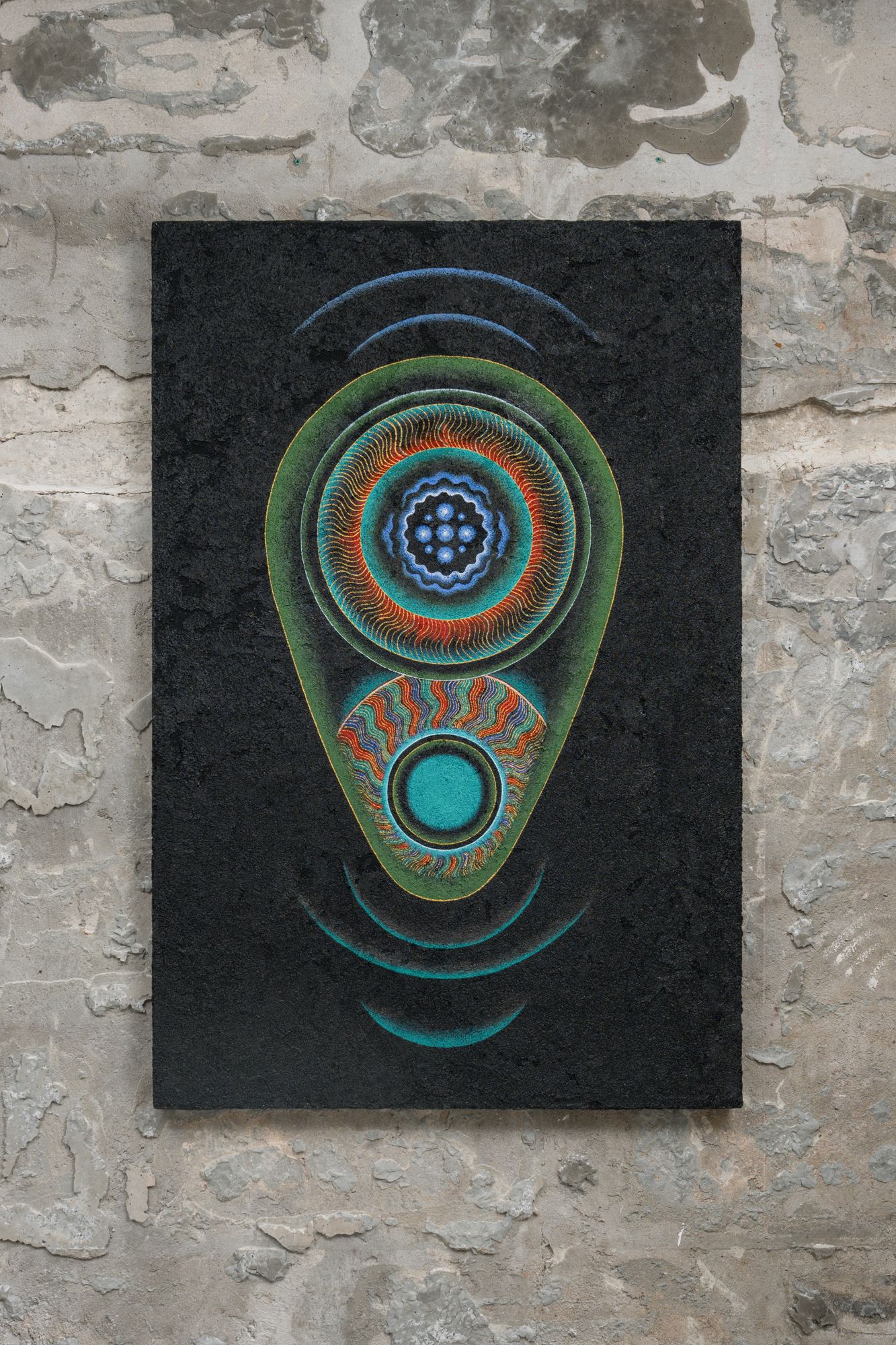
The folkloric painting series Egg That Has Spent the Night (2024-25), first shown at the 16th Sharjah Biennial in 2025, references Kim's interpretation of "night" as celestial realms of the subconscious, dreams, and maternal gestation. Rising out of obsidian darkness are forms reminiscent of alien spawn, energy auras, or the hyper-connected signals glowing on our screens, painted in the traditional style of dancheong typically used to decorate temples and sacred buildings in Korea.
These pluralistic connections, between the divine and the earthly, the exquisite and the ordinary, reveal Kim's belief that spiritual communion can be found in all places. Central to this idea is the ubiquitous symbol of the antenna, present in router devices, the tiny sensory organs of insects, and the ways our own bodies receive or emit signals. In the paintings, antenna signals appear as overlapping, concentric circles, giving mysterious fullness to the ovum shapes. In his ceramic sculptures, Kim counterbalances the celestial qualities of his paintings with more earthly revelations, suggesting that spiritual messages and resilience can be found even in ordinary places, such as a supermarket aisle or the shelves inside our fridges.